They shipped. Did it actually land?
Every competitor tool tells you something happened. That's the easy half. Track the handful of companies you really race against and see which of their moves the market cared about — and which ones went out to silence.
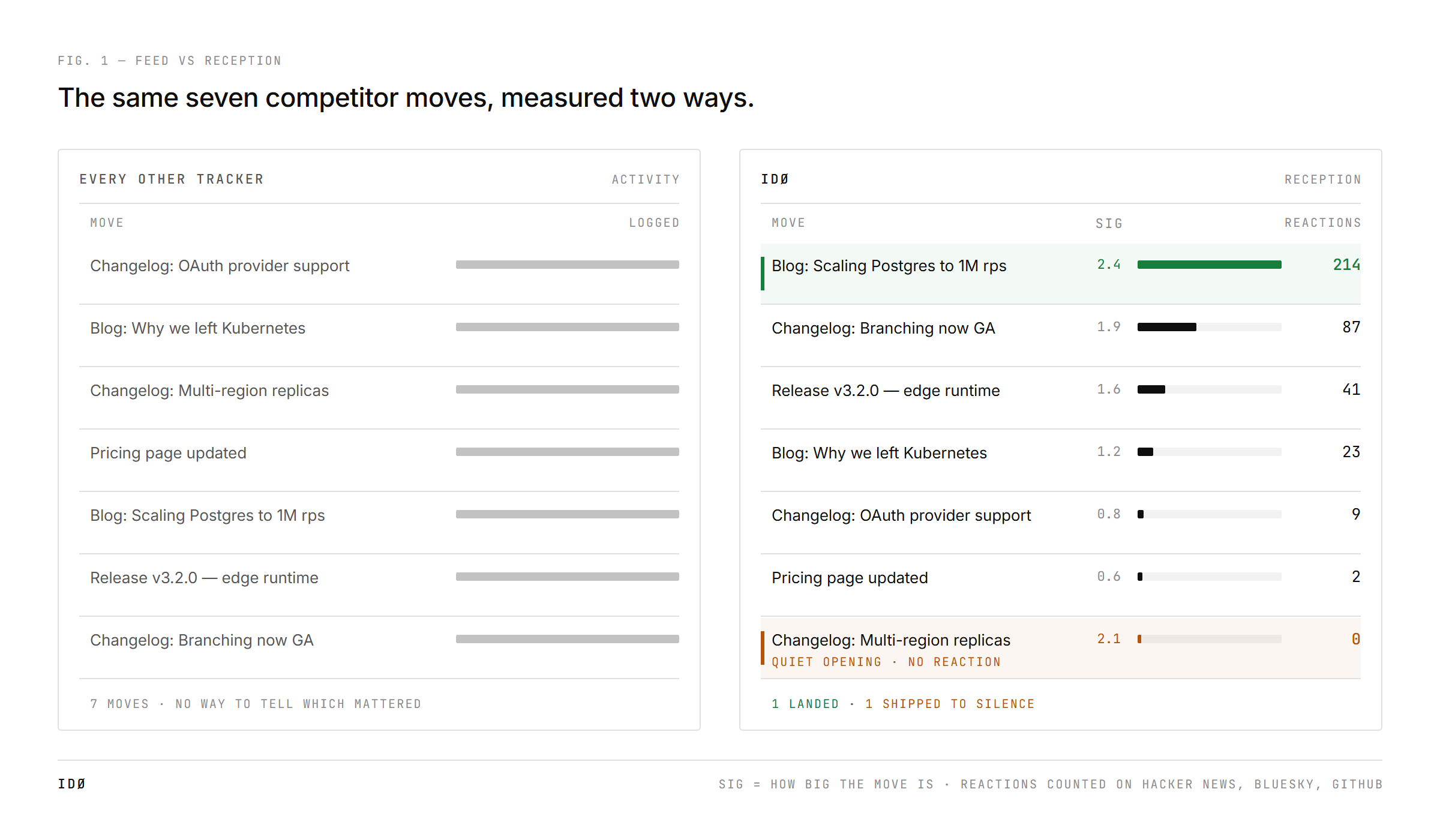
A feed tells you what shipped. It can't tell you what mattered.
A funding round announced into a skeptical room and a quiet feature ship developers adopted immediately look identical in a changelog feed. They are not remotely the same event. Sorting by recency is how you over-react to noise and miss the move that counts.
Eight companies, watched properly.
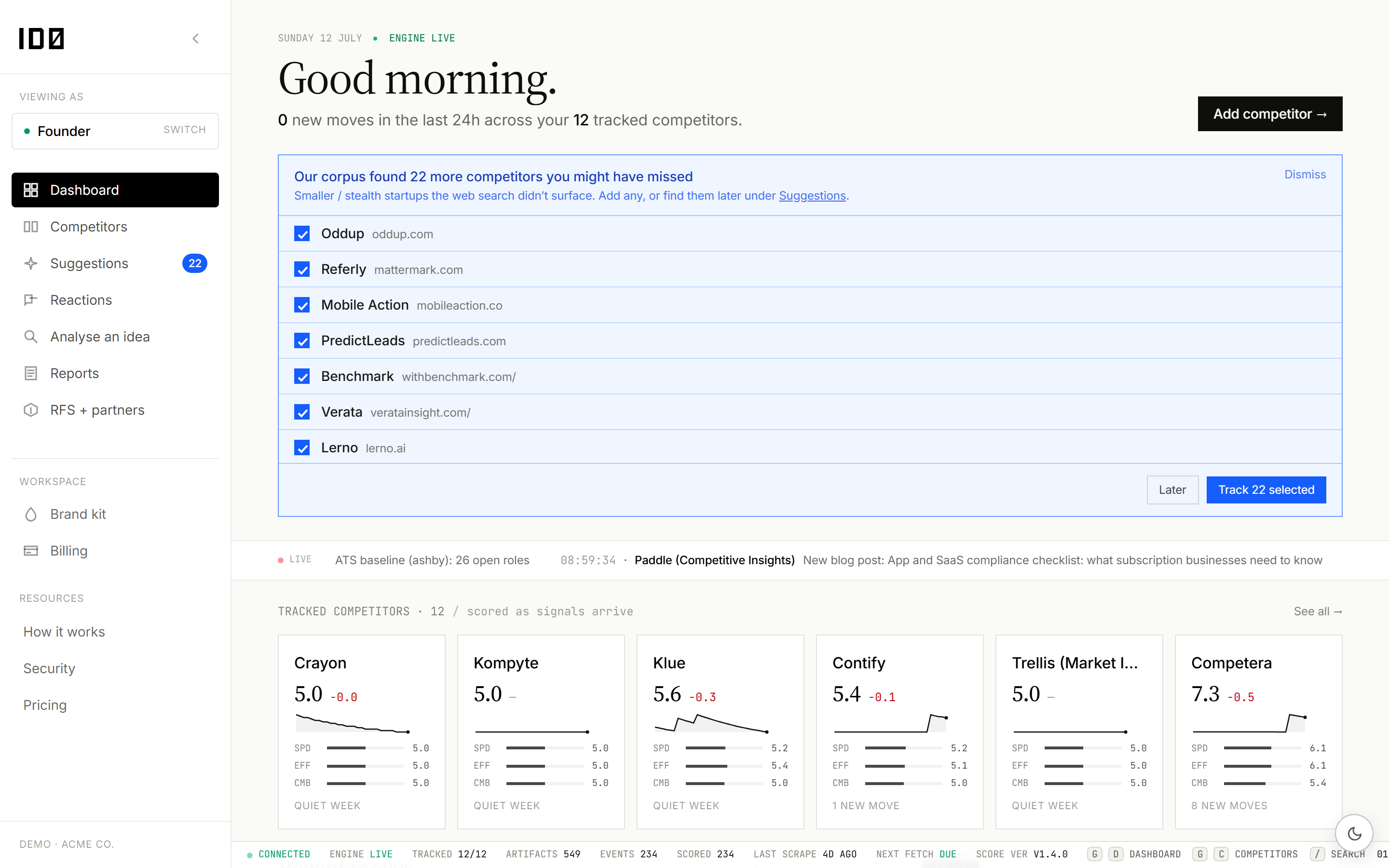
Add the companies you actually compete with. The engine watches their releases, pricing, hiring and public repos on a schedule, diffs every observation against the last one, and scores what changed. Nothing is inferred — a move exists because two snapshots disagree.
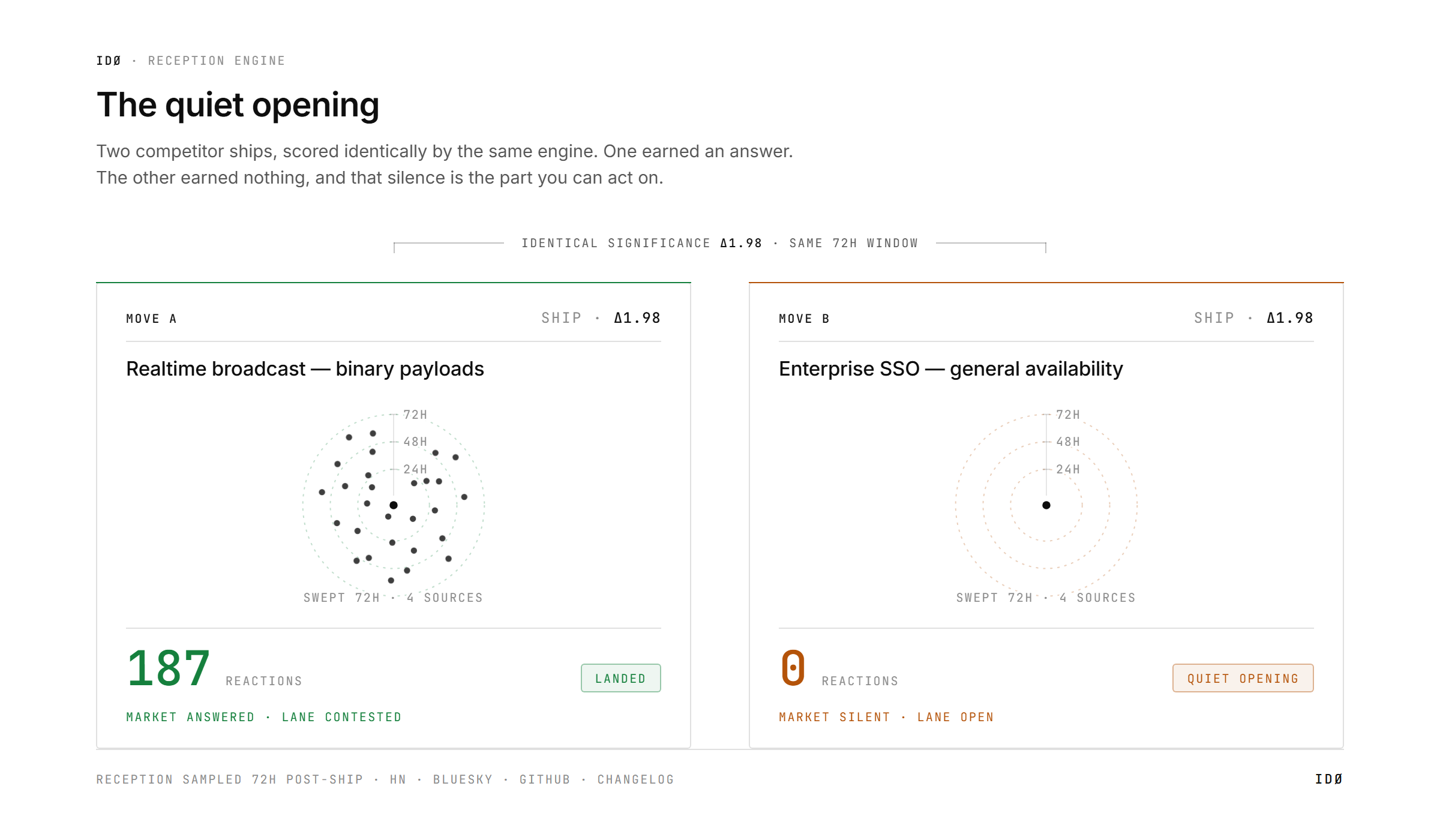
The most useful thing we find is a rival's silence.
When a competitor ships something genuinely significant and the market says nothing, that gap is the single most actionable signal in the product. It means the need wasn't felt, the framing missed, or the lane is still wide open. You only ever see it if reception is measured — a feed reports that launch as a win.
Four things, and honest labels on the rest.
8 competitors
live
Your real set
The companies you actually race against — not a 400-row market map.
HN · Bluesky · GitHub
live
Reception
The reaction each launch earned, coupled to that specific launch.
ranked by impact
live
Weekly brief
What shipped, what landed, what it means — one forwardable page.
high-signal only
soon
Alerts
Pushed only when a move is genuinely worth interrupting you.
What we won't do — and why that's the point.
Most of these are things a competitor-intelligence tool could ship tomorrow and charge for. Each one would cost the thing that makes the output worth reading.
No verdicts
We don't tell you to build it or kill it. You get evidence and the call stays yours.
No LLM in the score
The number comes from the diff and the measured reaction. Same inputs, same number, every time.
No uncited claims
Every line carries its source URL and timestamp. If we can't cite it, we don't show it.
No scraping LinkedIn
Hard constraint. We never hold your credentials for anything.
No notifying anyone
Nobody is told you're watching them. Read-only by architecture, not by policy.
No selling your data
Your tracked set is yours. It is not a dataset we resell.